

Business Registration in India: Complete Process, Documents and Costs
Business registration in India is one of the first and most important steps for anyone starting a business. Before the first invoice is raised or the first employee is hired, the business needs a legal identity. That identity comes from completing the business registration process that matches your business type.
The business structure you register under decides your personal liability if something goes wrong, how the business pays taxes, whether you can bring in investors, and how much compliance work you handle every year. Understanding how to register a business in India means first understanding which structure is right for you, because the registration process, documents required, and costs all depend on that single decision.
This article covers all five main business registration options in India, the documents required for each, registration costs, and what to do after registration to stay compliant.
A proper business registration in India helps entrepreneurs operate legally, maintain compliance, and build credibility with customers and partners.
Before Registration: Choose the Right Business Structure
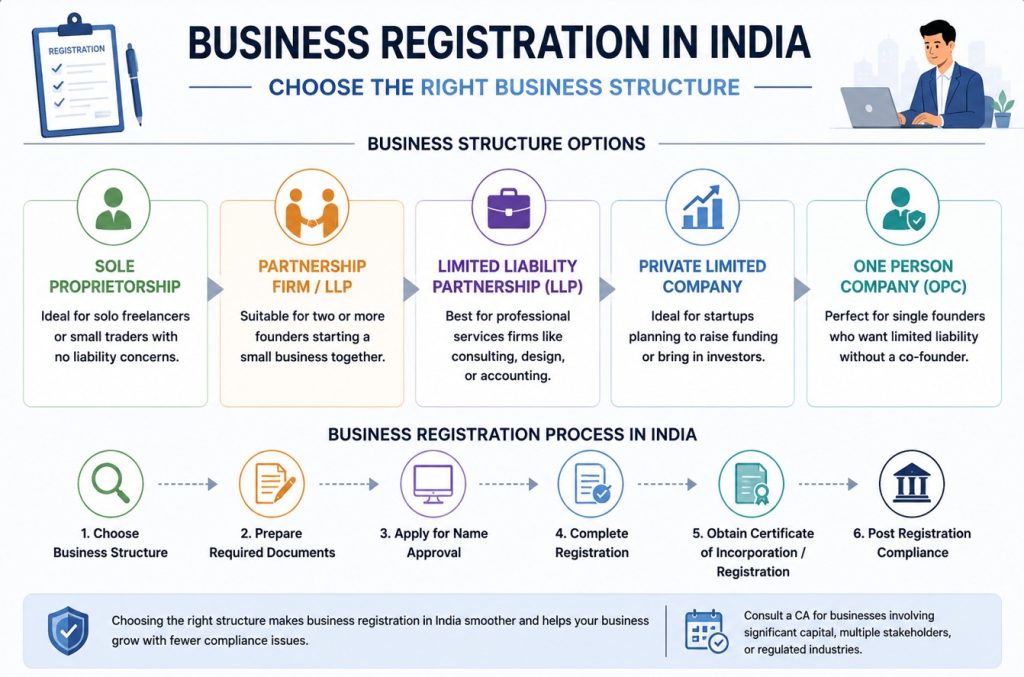
The single most important decision in the registration process is choosing the right business structure. This choice determines personal liability, tax treatment, compliance requirements, and how easy it will be to bring in partners or investors later. Changing the structure after registration is possible but time-consuming and often expensive.
The business registration process in India varies depending on whether you choose proprietorship, partnership, LLP, or company registration.
The table below summarizes the five main options available to business owners in India:
| Structure | Best For | Liability | Taxation | Investor Friendly | Compliance |
| Sole Proprietorship | Solo small businesses | Unlimited | Personal income tax | No | Very Low |
| Partnership Firm | 2+ co-founders | Unlimited | Firm taxed separately | No | Low |
| LLP | Professional services | Limited | Flat 30% on profits | Limited | Medium |
| Private Limited | Startups seeking funding | Limited | Flat 25-30% on profits | Yes | High |
| OPC | Solo + limited liability | Limited | Same as Pvt Ltd | No | Medium |
The right structure depends on the nature of the business, the number of people involved, the level of personal liability the owner is comfortable with, and whether the business plans to raise funding. A freelance consultant running a solo practice has very different needs from a tech startup planning to raise venture capital.
Which Business Structure Should You Choose?
Before going into the registration process for each structure, it helps to match your situation to the right option. A solo trader with low risk and no plans to raise funding has no reason to go through the complexity and cost of a Private Limited Company. Equally, a startup expecting to bring in investors cannot operate as a sole proprietorship because that structure does not allow equity sharing.
Solo business owner with no co-founder and no liability concerns: Sole Proprietorship is the fastest and cheapest option.
Two or more founders running a small business together: Partnership Firm for simplicity, or LLP if liability protection matters.
Professional services such as consulting, design, law, or accounting: LLP gives the right balance of protection and flexibility.
Startup planning to raise funding, hire a team, or scale significantly: Private Limited Company is the standard choice.
Single founder who wants limited liability without bringing in a co-founder: One Person Company (OPC) is the right fit.
Sole Proprietorship Registration in India
What It Is and Who Should Choose It
A sole proprietorship is the simplest business structure in India. The business and the owner are legally the same entity, which means there is no separate registration process for the business itself. The owner is personally liable for all debts and obligations of the business.
This structure works best for small businesses with a single owner, low risk of legal liability, and no immediate plans to bring in partners or investors. Local retailers, freelancers, home-based food businesses, and small service providers typically operate as sole proprietorships.
Registration Process
There is no formal central registration for a sole proprietorship. The business is established through obtaining the licenses and registrations relevant to its specific activity. At minimum, this includes a current bank account opened in the business name (which requires proof of business existence such as a trade license or GST registration), GST registration if turnover crosses the threshold or if the owner wants to claim input tax credit, and a trade license from the local municipal body if required by the business type.
Documents Required
PAN card of the owner, Aadhaar card, a bank account in the business name, address proof for the business location, and any activity-specific license such as FSSAI for food businesses or a shop establishment certificate.
Cost
Registration costs for a sole proprietorship are minimal typically between 2,500 and 7,000 rupees including professional fees for GST registration and trade license applications. This makes it the lowest-cost entry point for starting a formal business in India.
Partnership Firm Registration in India
What It Is and Who Should Choose It
A partnership firm involves two or more people running a business together under a Partnership Deed that defines the rights, responsibilities, and profit-sharing arrangement of each partner. Like a sole proprietorship, partners in a traditional partnership firm have unlimited personal liability for the firm’s obligations.
Partnership firms work well for small businesses with two to three founders who know each other well and want a simple, low-cost structure. Family businesses, small trading firms, and local professional practices often use this structure.
Registration Process
Partnership firms can be registered with the Registrar of Firms in the relevant state, although registration is technically optional under the Indian Partnership Act. However, an unregistered firm cannot sue a third party to enforce its rights, which makes registration practically important. The process involves drafting a Partnership Deed, paying the applicable stamp duty, and submitting the deed along with an application form to the Registrar of Firms.
Documents Required
Application form for registration, Partnership Deed on stamp paper with the signatures of all partners, PAN and Aadhaar of all partners, address proof of the firm’s principal place of business, and passport-size photographs of all partners.
Cost
Total costs typically range from 4,000 to 10,000 rupees including stamp duty on the Partnership Deed and professional fees. Stamp duty varies by state.
LLP Registration in India
What It Is and Who Should Choose It
A Limited Liability Partnership combines the flexibility of a partnership with the limited liability protection of a company. In an LLP, each partner’s personal assets are protected from the firm’s debts and liabilities. The LLP itself is a separate legal entity that can own assets, enter contracts, and sue or be sued in its own name.
LLPs are popular among professional service firms consultants, architects, chartered accountants, lawyers, and design studios because they offer liability protection and a formal legal identity without the heavier compliance burden of a private limited company.
Registration Process
LLP registration is done through the Ministry of Corporate Affairs (MCA) portal. The process involves obtaining a Digital Signature Certificate (DSC) for designated partners, applying for a Director Identification Number (DPIN), reserving the LLP name through the RUN-LLP form, filing the incorporation form (FiLLiP) with the MCA, and drafting and filing the LLP Agreement within 30 days of incorporation.
Documents Required
PAN and Aadhaar of all designated partners, address proof of all partners, proof of registered office address (rent agreement or ownership document with NOC from owner), passport-size photographs, Digital Signature Certificates, and the drafted LLP Agreement.
Cost
Government fees for LLP registration range from 500 to 5,000 rupees depending on the contribution amount. Professional fees for handling the end-to-end process typically range from 5,000 to 12,000 rupees. Total cost estimate is 5,500 to 17,000 rupees.
Private Limited Company Registration in India
What It Is and Who Should Choose It
A Private Limited Company is the most commonly used structure for startups and growth-oriented businesses in India. It is a separate legal entity, shareholders have limited liability, shares can be transferred subject to restrictions, and it is the structure required by most institutional investors and venture capital firms.
The compliance requirements are higher than other structures annual filings with the MCA, statutory audits, board meetings, and more but the credibility, funding eligibility, and scalability that come with a Pvt Ltd structure make it the right choice for businesses planning to hire, raise capital, or scale significantly.
Registration Process
Registration is done through the MCA portal using the SPICe+ (Simplified Proforma for Incorporating Company Electronically Plus) form, which integrates multiple registrations into a single application. The process includes obtaining DSCs for all directors, applying for Director Identification Numbers (DINs), reserving the company name, filing SPICe+ with the Memorandum of Association (MoA) and Articles of Association (AoA), and receiving the Certificate of Incorporation from the Registrar of Companies.
Documents Required
PAN and Aadhaar of all directors and shareholders, address proof of all directors, proof of registered office address, passport-size photographs, Digital Signature Certificates, drafted MoA and AoA, and a declaration by the first directors and subscribers.
Cost
Government fees vary based on authorized capital, typically ranging from 1,000 to 7,000 rupees. Professional fees for end-to-end handling range from 8,000 to 20,000 rupees. Total cost estimate is 9,000 to 27,000 rupees.
One Person Company (OPC) Registration in India
What It Is and Who Should Choose It
A One Person Company allows a single individual to incorporate a company with limited liability combining the simplicity of a sole proprietorship with the legal protection of a private limited company. The OPC must have one director and one nominee director (who takes over if the original director is unable to continue).
OPC is well-suited for solo entrepreneurs who want formal company status and liability protection without bringing in additional shareholders or partners. Freelancers with significant income, independent consultants, and solo product creators who want to scale their operations often choose this structure.
Registration Process
The registration process is similar to a Private Limited Company and is done through the MCA portal via the SPICe+ form. The key difference is that only one shareholder and one director are required, and a nominee must be identified at the time of incorporation.
Documents Required
PAN and Aadhaar of the sole member and nominee, address proof, registered office proof, Digital Signature Certificate, passport-size photographs, drafted MoA and AoA, and a written consent from the nominee.
Cost
Government fees typically range from 1,000 to 5,000 rupees. Professional fees range from 6,000 to 15,000 rupees. Total cost estimate is 7,000 to 20,000 rupees.
Documents Required for Business Registration in India
While specific documents vary by structure, the following are required across almost all business registration types in India:
PAN Card: Mandatory for the owner, all founders, or directors.
Aadhaar Card: Identity and address proof for all individuals involved.
Address Proof for Business Location: Rent agreement with NOC from property owner, utility bill, or ownership documents.
Passport-size Photographs: Required for most application forms.
Digital Signature Certificate (DSC): Required for LLP, OPC, and Private Limited Company registrations.
Activity-specific Licenses: FSSAI for food businesses, MSME Udyam registration for manufacturing or service units, and state-specific trade or establishment licenses as applicable.
For company and LLP registrations, drafted legal documents such as MoA, AoA, LLP Agreement, and partner or director declarations are also required before filing.
Business Registration Cost in India
The table below provides a consolidated cost comparison across all five structures. Figures are approximate and may vary by state and professional service provider:
| Structure | Govt Fee (Approx) | Professional Fee (Approx) | Total Estimate |
| Sole Proprietorship | 500–2,000 | 2,000–5,000 | 2,500–7,000 |
| Partnership Firm | 1,000–3,000 | 3,000–7,000 | 4,000–10,000 |
| LLP | 500–5,000 | 5,000–12,000 | 5,500–17,000 |
| Private Limited Company | 1,000–7,000 | 8,000–20,000 | 9,000–27,000 |
| OPC | 1,000–5,000 | 6,000–15,000 | 7,000–20,000 |
These figures are approximate and can vary based on the state of registration, the authorized capital amount for companies, and the professional service provider engaged. States like Maharashtra and Karnataka may have higher stamp duty on Partnership Deeds compared to states like Rajasthan or Uttar Pradesh. Consulting a local CA before finalizing budget estimates is advisable.
Additional costs to budget for after registration include GST filing fees, accounting and bookkeeping, annual compliance filings for LLPs and Pvt Ltd companies, activity-specific licenses, and any state-level registrations. For Private Limited Companies, statutory audit fees are also mandatory each year. Planning for these ongoing costs from the start avoids surprises once the business is operational.
What Happens After Business Registration?
Completing business registration in India is the beginning of the compliance journey, not the end. Several important steps need to be completed after the business is formally registered.
GST Registration
Businesses with an annual turnover above 40 lakhs (20 lakhs for service businesses) are required to register for GST. Even businesses below the threshold often choose to register voluntarily to claim input tax credit and to appear credible to larger clients who prefer GST-registered vendors.
Business Bank Account
A current account in the business name should be opened immediately after registration. This keeps personal and business finances separate, which is important for accounting accuracy, tax compliance, and building a credit history for the business.
MSME Udyam Registration
Registering under the MSME Udyam portal is free and provides access to government schemes, priority lending, lower interest rates on business loans, and eligibility for government procurement preferences. Any business qualifying as a micro, small, or medium enterprise should complete this registration.
Annual Compliance Filings
Private Limited Companies and LLPs have mandatory annual filing requirements with the MCA, including financial statements and annual returns. Missing these filings attracts penalties and can lead to the company being struck off the register. Engaging a CA or company secretary for ongoing compliance management is advisable for these structures.
Professional Licenses
Depending on the business activity, additional licenses may be required before operations begin. These include FSSAI for food businesses, a fire safety NOC for premises open to the public, professional body registrations for regulated industries, and state-specific trade or establishment licenses.
Frequently Asked Questions
Can I register a business in India without a CA or lawyer?
Yes for simpler structures like sole proprietorships, self-registration is entirely possible. For LLPs and Private Limited Companies, the MCA portal allows direct filing, but the process involves multiple forms, DSC applications, and legal documents. Most founders find that engaging a CA or company secretary saves time, reduces errors, and costs less than fixing mistakes made during self-filing.
How many days does business registration take in India?
Timelines vary by state and document completeness. Sole Proprietorship: 7 to 15 working days. Partnership Firm: 10 to 20 working days. LLP: 15 to 25 working days. Private Limited Company: 10 to 20 working days. OPC: 15 to 25 working days. Delays can occur due to name rejection or document issues, so build extra buffer time especially for LLP and Pvt Ltd registrations.
Which business structure is best for a first-time entrepreneur in India?
For most first-time entrepreneurs starting small, a sole proprietorship is the simplest and lowest-cost option. If the business involves two or more founders, an LLP offers liability protection with manageable compliance. A Private Limited Company is the right choice only when the business has clear plans to raise funding, hire significantly, or scale rapidly because the compliance burden is higher and the benefits are most valuable in those specific situations.
Is MSME registration mandatory in India?
MSME Udyam registration is not mandatory, but it is strongly recommended for eligible businesses. It is free, can be done online without a CA, and provides access to government schemes, subsidized loans, and priority procurement opportunities. For any small or medium business in India, there is very little reason not to register.
Which business registration is best for a small business in India?
For most small businesses with a single owner and limited risk, a sole proprietorship is the simplest and most cost-effective starting point. If two or more founders are involved, an LLP offers liability protection with lower compliance than a Private Limited Company. A Pvt Ltd is the right choice when the business plans to raise funding, hire significantly, or scale to a larger operation. The best registration is the one that matches the actual current size and future ambition of the business, not the most complex option available.
Quick Decision Guide: Which Structure Should You Choose?
- Solo freelancer or small trader with no liability concerns: Sole Proprietorship.
- Two or more founders starting a small business together: Partnership Firm or LLP.
- Professional services firm such as consulting, design, or accounting: LLP.
- Startup planning to raise funding or bring in investors: Private Limited Company.
- Single founder who wants limited liability without a co-founder: One Person Company (OPC).
This business registration in India guide covers the most common scenarios. When the business involves significant capital, multiple stakeholders, or regulated industries, consulting a CA before choosing a structure is advisable.
Choosing the right structure makes business registration in India smoother and helps your business grow with fewer compliance issues.