

Internships for College Students: Types, Benefits and How to Apply
Landing the right internships for college students can shape the entire trajectory of your career, often more than the degree itself. Employers increasingly value hands-on experience over textbook knowledge, and a well-chosen internship gives you exactly that. Whether you are in your first year exploring options or in your final year racing toward placement season, understanding how internships actually work, what types exist, and how to apply strategically can save you months of confusion and rejection.
This guide breaks down everything a college student needs to know before applying for an internship, including practical steps that most generic career articles skip entirely.
Why Internships Matter More Than Ever for College Students
The job market has shifted noticeably in the last decade. Recruiters across sectors now treat internship experience as a baseline filter rather than a bonus, particularly for entry-level roles in technology, marketing, finance, and design.
Beyond resume value, internships expose students to workplace culture, professional communication, and real deadlines, none of which a classroom can fully replicate. A student who has completed even one structured internship typically adapts faster to a full-time role than one who has not, simply because the learning curve around office tools, reporting structures, and client interaction has already been crossed.
There is also a financial angle. Many internships, especially in technical and corporate roles, now offer stipends ranging from a few thousand rupees to amounts comparable to entry-level salaries, making them genuinely useful for students managing their own expenses during college.
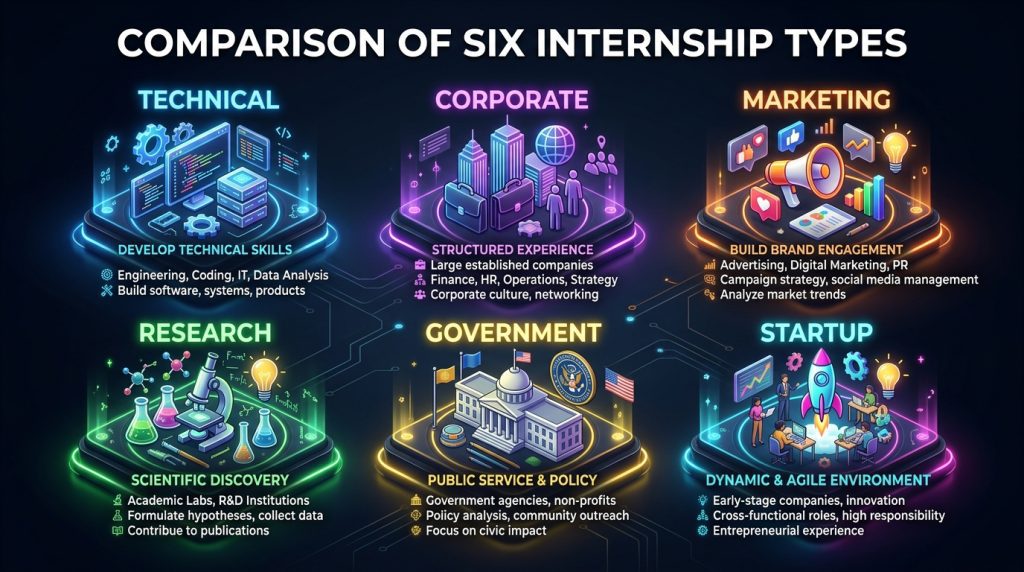
Types of Internships for College Students
Technical and Engineering Internships
These cover roles in software development, data analysis, mechanical design, and core engineering functions. Companies typically look for students with strong fundamentals in programming languages, CAD tools, or domain-specific software, depending on the branch.
Corporate and Business Internships
Roles in finance, human resources, operations, and business analysis fall under this category. Most require strong analytical thinking, spreadsheet proficiency, and basic understanding of business processes, which students usually pick up through case competitions or coursework.
Marketing and Content Internships
Digital marketing, social media management, and content writing internships have grown rapidly, partly because they can often be done remotely. These roles suit students who enjoy writing, design tools, or analytics platforms like Google Analytics.
Research and Academic Internships
Universities and research institutions frequently offer summer research internships, particularly for students in science and pure research streams. These internships often lead directly to publications or strengthen applications for higher studies.
Government and Public Sector Internships
Several government ministries and public sector undertakings run structured internship programs, giving students exposure to policy work, public administration, and large-scale project execution that private sector roles rarely offer at the entry level.
Startup Internships
Startups generally offer broader responsibility early on, since smaller teams mean interns often work directly with founders or senior team members. The trade-off is usually less structured mentorship compared to larger organizations.
Eligibility and Skills Required for Internships
Most internships for college students require candidates to be currently enrolled in a recognized undergraduate or postgraduate program, typically from the second year onward, though some open applications to first-year students as well.
Beyond academic eligibility, recruiters consistently prioritize a few core skills regardless of the field. Communication ability, basic proficiency in tools relevant to the role, and a demonstrated interest through projects or coursework matter more than a high grade point average alone. Many recruiters specifically mention that a strong personal project or portfolio carries more weight than academic rank during internship shortlisting.
Comparing Internship Types by Key Factors
The table below compares the major internship categories across factors students usually care about most.
| Internship Type | Typical Stipend Range | Remote Availability | Skill Barrier | Best Suited For |
|---|---|---|---|---|
| Technical/Engineering | Rs. 8,000 to Rs. 50,000+ | Partial | High | Engineering and CS students |
| Corporate/Business | Rs. 5,000 to Rs. 30,000 | Low | Moderate | Commerce and management students |
| Marketing/Content | Rs. 3,000 to Rs. 20,000 | High | Low to Moderate | Any stream with writing or design interest |
| Research/Academic | Stipend or unpaid | Low | High | Science and research-oriented students |
| Government/Public Sector | Rs. 5,000 to Rs. 15,000 | Low | Moderate | Students interested in policy or administration |
| Startup Roles | Rs. 5,000 to Rs. 25,000 | High | Variable | Students wanting broader exposure |
How to Apply for Internships for College Students
Securing a good internship rarely happens through a single application sent to a job portal. It usually involves a combination of approaches working together.
Direct outreach to companies, even without an open posting, often works better than waiting for advertised vacancies. A short, specific email expressing interest in a particular team, along with a relevant project sample, frequently gets more responses than generic applications submitted through portals.
University placement cells and career centers also maintain internship listings that are not always public, so registering early and staying in touch with the placement office gives access to opportunities other students might miss entirely.
Building a visible portfolio, whether through GitHub for technical students, a personal blog for content roles, or a LinkedIn profile showcasing projects, significantly increases response rates from recruiters who often screen candidates informally before any formal application review.
Internship fairs and college-organized recruitment drives remain useful, particularly for first-time applicants who benefit from direct interaction with company representatives rather than navigating online applications alone.

Common Mistakes Students Make While Applying
A frequent mistake is applying to dozens of internships with an identical, generic resume and cover letter. Recruiters can usually tell within seconds when an application has not been tailored to their specific role, which reduces response rates significantly.
Another common issue is underestimating the importance of soft skills during interviews. Many students focus entirely on technical preparation while overlooking basic interview etiquette, clear communication, and the ability to explain their own projects confidently.
Waiting too long to start applying is equally damaging. Strong internship cycles, particularly for summer programs at larger companies, often open six to eight months in advance, meaning students who start searching only a month before summer frequently miss the best opportunities.
Making the Most of an Internship Once Selected
Getting selected is only the starting point. Students who treat their internship as a genuine learning opportunity, rather than just a resume line item, tend to receive stronger recommendation letters and sometimes even full-time offers afterward.
Asking for feedback regularly, taking initiative beyond assigned tasks, and documenting your contributions throughout the internship period all help when it comes time to update your resume or request a reference later. Many students who later pursue government exams, including pathways covered in our guide on <a href=”/government-exams-after-12th”>government exams after 12th</a>, find that the discipline and time management developed during an internship transfers directly into structured exam preparation.
For students specifically exploring remote opportunities, official skilling and internship initiatives listed under the Ministry of Skill Development and Entrepreneurship provide verified programs that are useful to cross-check before applying through third-party platforms.
How Internships Influence Full-Time Placement Outcomes
Companies frequently use internships as an extended interview process, particularly for management trainee and graduate engineer trainee tracks. A strong internship performance often leads directly to a pre-placement offer, which removes the need to compete in the general placement pool entirely.
Even when a pre-placement offer is not extended, the internship still strengthens a student’s resume considerably for other applications, since recruiters view verified work experience as a stronger signal than academic achievement alone.
Frequently Asked Questions
At what year of college should I start applying for internships?
Most students start applying from their second year onward, though first-year students can pursue smaller, less competitive internships to build initial experience and confidence.
Are unpaid internships worth doing?
Unpaid internships can be worthwhile if they offer strong mentorship, brand value, or skill development that is difficult to access otherwise, though paid internships are generally preferable when available in a similar role.
How long do most college internships last?
Internship duration typically ranges from six weeks during summer breaks to six months for semester-long or live-in programs, depending on the company and academic calendar.
Can I do an internship and continue regular college classes?
Yes, many internships, particularly remote and part-time roles, are structured to accommodate ongoing coursework, though full-time internships usually require a semester break or formal leave arrangement.
Do internships guarantee a full-time job offer?
Not always, but strong performance during an internship significantly increases the likelihood of receiving a pre-placement offer or a strong recommendation for future roles.
What is the difference between an internship and an apprenticeship?
Internships are generally shorter, exploratory, and education-focused, while apprenticeships are longer, more structured, and often tied to a formal skill certification or trade qualification.
How many internships should a college student complete before graduating?
There is no fixed number, but completing two to three internships across different roles or industries before graduation gives students a clearer sense of their career direction and a stronger overall resume.
Are virtual internships as valuable as in-office ones?
Virtual internships can be equally valuable for skill-building, particularly in technical and content-based roles, though in-office internships often provide stronger networking and mentorship opportunities.
Choosing the Right Government Career After 12th
Choosing the right internship comes down to matching your current skills and long-term goals with the opportunities realistically available to you, rather than chasing the most popular or highest-paying option by default. Starting early, tailoring every application, and treating the internship period as genuine work experience rather than a formality will consistently produce better outcomes than simply collecting certificates for a resume.
Students who approach internships with this mindset typically find that doors open faster, both for full-time placement and for any future government or competitive exam path they choose to pursue alongside their college years.