
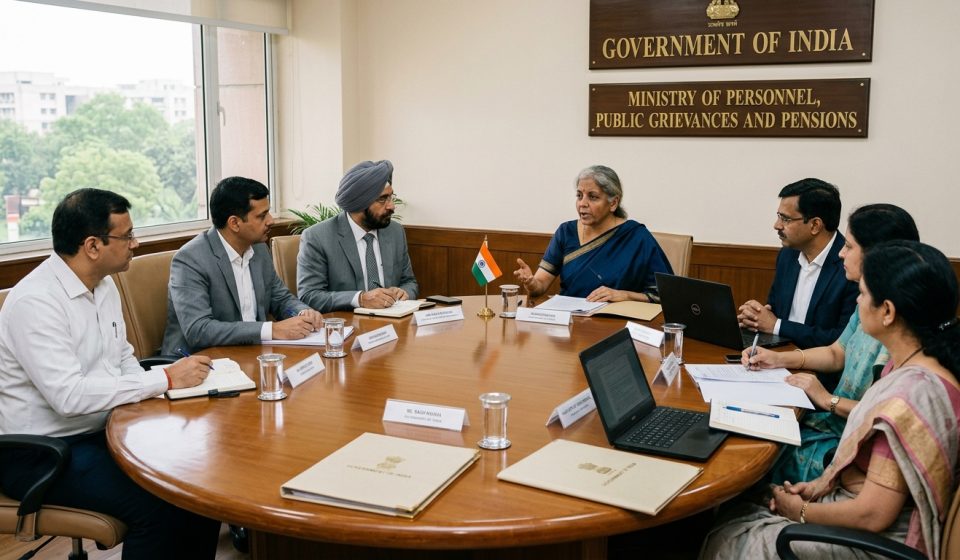
How to Become an IAS Officer After 12th
The Indian Administrative Service remains one of the most respected career paths in the country. For students who have just completed Class 12, the question is not whether the IAS is a worthy goal, but how to build toward it in a way that is practical, structured, and achievable. The path to becoming an IAS officer after 12th does not begin with UPSC — it begins with the choices made during graduation and the habits built in those years before the examination itself.
Why Becoming an IAS Officer Remains a Top Career Choice
IAS officers hold positions at the centre of governance, shaping policy, managing public administration, and representing the state in districts across the country. The role comes with authority, responsibility, and a career structure that offers both stability and impact. Unlike most private sector roles, the work of an IAS officer is directly visible in the communities they serve — from disaster relief coordination to infrastructure decisions and revenue administration.
Beyond the professional scope, the IAS offers one of the most secure career paths in India, with defined grades from Sub-Divisional Magistrate to Cabinet Secretary, and a salary structure that grows progressively through the pay commission framework. For students finishing school with a strong academic foundation and an interest in governance, beginning IAS preparation after 12th gives a significant head start over those who come to the examination later.
Can You Become an IAS Officer Directly After 12th?
No. The UPSC Civil Services Examination requires candidates to hold a graduation degree from a recognised university before they can apply. A student who has just passed Class 12 is not yet eligible to sit for the UPSC CSE, regardless of how strong their academic record is.
However, the years between Class 12 and graduation are not waiting time — they are preparation time. Students who use their undergraduate years to build general knowledge, read widely, follow current affairs, and develop analytical thinking arrive at the UPSC examination significantly better prepared than those who begin only after completing graduation. Starting your IAS preparation after 12th means you enter the exam with three to four years of consistent groundwork already in place.
How to Become an IAS Officer After 12th: The Complete Journey
The typical timeline for a student aiming to become an IAS officer after 12th looks like this: three years of graduation (or four for honours programs), followed by appearing in the UPSC Civil Services Examination, which has three stages — Prelims, Mains, and the Personality Test. Candidates who clear all three stages are recommended for the IAS or other allied services based on their rank and preference.
The entire journey from Class 12 to IAS selection generally takes five to seven years for most successful candidates, accounting for one or more attempts at the UPSC examination. The age limit allows candidates up to 32 years for general category (with relaxation for reserved categories), which means students have multiple attempts and enough runway to build a strong preparation over time.
UPSC Eligibility Criteria for IAS Aspirants
Understanding the eligibility requirements clearly helps aspirants plan their academic path without unnecessary confusion.
| Requirement | Details |
| Educational Qualification | Graduation from a recognised university (any stream) |
| Minimum Age | 21 years at the time of application |
| Maximum Age | 32 years (General) | 35 years (OBC) | 37 years (SC/ST) |
| Number of Attempts | 6 (General) | 9 (OBC) | Unlimited (SC/ST, within age limit) |
| Nationality | Indian citizen |
| Exam | UPSC Civil Services Examination (CSE) |
Students in any graduation stream — science, commerce, or arts — are eligible to appear for the UPSC CSE. There is no requirement to study a specific subject at the undergraduate level to qualify for the IAS examination.
Choosing the Right Graduation Path for IAS Aspirants
Since graduation is a mandatory eligibility requirement, the choice of undergraduate course matters both for completing the degree and for building subject knowledge relevant to the UPSC examination.
Humanities and social science programs such as History, Political Science, Public Administration, Sociology, and Geography are popular among IAS aspirants because the syllabi overlap significantly with the UPSC Mains General Studies papers and optional subject choices. That said, students from science or commerce backgrounds perform equally well in the IAS — what matters more is how the candidate builds on their undergraduate years through consistent general awareness and reading.
Choosing a college with a manageable workload, access to a good library, and a peer group that takes competitive examinations seriously can make the undergraduate years significantly more productive for IAS preparation.
IAS Preparation After 12th: Building the Right Foundation
The foundation for IAS success is built long before a candidate registers for the UPSC examination. Students who use their post-12th years well arrive at the exam with habits and knowledge that cannot be acquired in a short preparation sprint.
Reading newspapers daily: The Hindu and Indian Express are standard references for UPSC current affairs. Developing the habit of reading and retaining news analysis during graduation builds a base that supports both Prelims and Mains preparation.
NCERT books as foundation: NCERT textbooks from Classes 6 to 12 in History, Geography, Polity, Economics, and Science form the backbone of UPSC Prelims knowledge. Reading these during graduation, even alongside your degree subjects, gives a strong conceptual foundation.
Building analytical writing skills: The UPSC Mains examination tests the ability to present arguments clearly and within word limits. Practising essay writing and answer writing from the early years of graduation is far more effective than starting this skill from scratch after completing the degree.
Following government schemes and policies: IAS aspirants need awareness of central and state government programs, budget highlights, and policy changes. Tracking these during graduation — rather than memorising them in a rushed pre-exam phase — makes retention significantly easier.
How to Prepare for IAS During Graduation
Balancing a degree program and IAS preparation requires a structured approach rather than trying to cover everything at once.
The first year of graduation is best used to cover NCERT basics and establish reading habits. The second year can be used to begin the standard UPSC reference books in subjects like Polity (Laxmikanth), Modern History (Spectrum), and Geography (GC Leong). By the third year, the focus should shift to previous year question analysis, mock tests, and identifying the optional subject for UPSC Mains.
Aspirants who try to cover the entire UPSC syllabus only after graduation often struggle with the volume of material. Spreading foundational reading over the undergraduate years makes the formal preparation phase after graduation more manageable and focused.
Understanding the UPSC Civil Services Examination
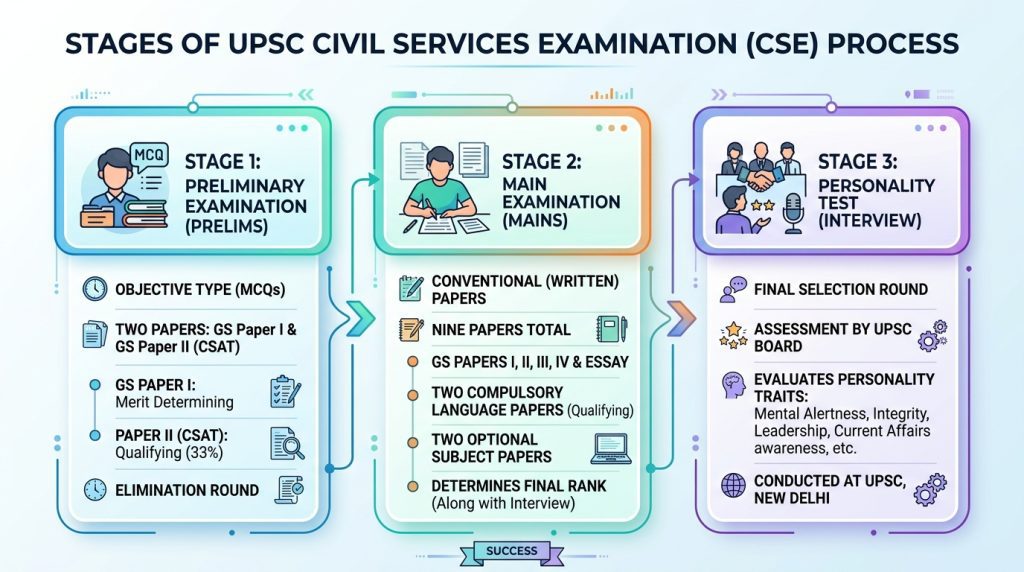
The UPSC Civil Services Examination is conducted in three stages. Understanding the structure early helps aspirants align their preparation with what the examination actually tests.
| Stage | Format | Purpose |
| Prelims | Two objective papers (GS Paper I + CSAT) | Screening test to shortlist candidates for Mains |
| Mains | Nine descriptive papers including essay and optional subject | Primary ranking stage testing depth and writing ability |
| Interview | Personality Test conducted by UPSC board | Assessment of communication, reasoning, and suitability for civil services |
Only candidates who clear Prelims are eligible to appear for Mains, and only those who clear Mains are called for the Interview. The final merit list is based on Mains and Interview scores combined, not Prelims.
Best Books and Resources for IAS Preparation
No single book covers the entire UPSC syllabus. The standard approach among successful candidates is to build a reading list that covers each major subject area without excessive duplication.
Indian Polity by M. Laxmikanth: The most widely used reference for the Constitution, governance, and political system sections of both Prelims and Mains.
A Brief History of Modern India by Spectrum: Covers the modern Indian history section that appears consistently in UPSC Prelims and as part of Mains GS Paper I.
Indian Economy by Ramesh Singh: Standard reference for economic concepts, government schemes, and budget-related topics that form a significant portion of GS Paper III.
Certificate Physical and Human Geography by GC Leong: A foundational geography text used widely for both physical geography and Indian geography sections.
NCERT textbooks (Classes 6 to 12): These remain the most important foundation texts across all subjects and should be completed before moving to any advanced reference book.
Creating an Effective UPSC Study Schedule
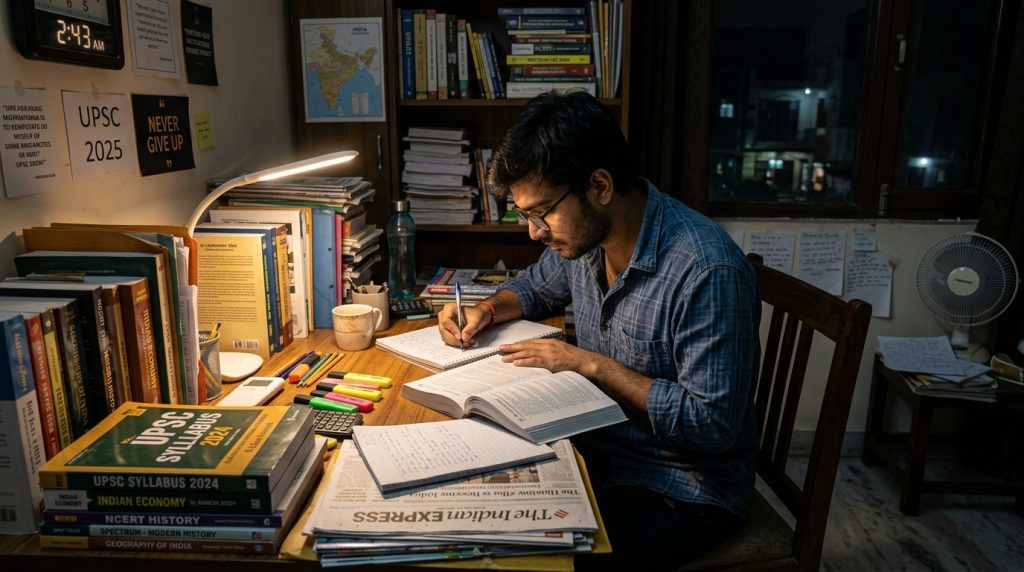
A realistic daily schedule during graduation should dedicate two to three hours specifically to IAS preparation without disrupting academic requirements. This is enough to cover NCERTs, follow current affairs, and build conceptual clarity over three years.
Weekly revision is more effective than linear reading without review. Aspirants who spend one day per week reviewing what they covered earlier in the week retain significantly more than those who read continuously without revision cycles.
For students who want a structured time table, the UPSC official website publishes the syllabus and previous year papers, which are the most reliable starting point for planning any preparation schedule.
Sample Daily Timetable for UPSC Preparation During Graduation
A sample daily routine helps translate the study schedule above into a practical structure that fits around graduation classes rather than competing with them.
| Time | Activity |
| 6:00 AM to 7:00 AM | Newspaper reading and current affairs notes |
| 7:00 AM to 9:00 AM | Graduation classes and academic study |
| Afternoon | NCERT reading or standard reference books |
| Evening | Answer writing or essay practice |
| Night | Weekly revision of subjects covered earlier |
This routine is a starting structure, not a fixed rule. Aspirants can adjust the time blocks based on their college schedule, as long as the daily habit of newspaper reading, NCERT study, and weekly revision stays consistent.
IAS Officer Salary, Responsibilities and Career Growth
The pay structure for IAS officers follows the 7th Central Pay Commission framework. Entry level IAS officers (Junior Time Scale) receive a basic pay of approximately Rs 56,100 per month, with additional allowances including House Rent Allowance, Dearness Allowance, and travel entitlements that vary based on posting location.
As officers progress through the hierarchy — from Sub-Divisional Magistrate to District Collector, Divisional Commissioner, Secretary at the state level, and finally positions in the Central Government — both the pay and the scope of responsibility increase significantly. Officers in the Senior Administrative Grade receive basic pay in the range of Rs 1,00,000 to Rs 2,05,400 per month.
Beyond salary, IAS officers receive government accommodation, official vehicles for official use, and a defined pension structure post-retirement, making the overall compensation package highly secure compared to most private sector equivalents at similar responsibility levels.
| Position | Approx Basic Pay |
| IAS Officer (Junior Time Scale) | Approx Rs 56,100 per month |
| Senior Time Scale | Approx Rs 67,700 per month |
| District Collector / Magistrate | Approx Rs 78,800 to Rs 1,18,500 per month |
| Secretary (State Government) | Approx Rs 1,44,200 to Rs 1,82,200 per month |
| Senior Administrative Grade | Rs 1,00,000 to Rs 2,05,400 per month |
| Cabinet Secretary | Rs 2,50,000 per month (fixed) |
Common Mistakes That Delay UPSC Success
Waiting until after graduation to start: The most common mistake among IAS aspirants is treating preparation as something that begins only after the degree is complete. Three years of foundational reading during graduation dramatically improves both the quality and speed of formal preparation later.
Covering too many books on the same subject: The UPSC rewards depth and clarity, not the number of books read. Aspirants who read five books on modern history often retain less than those who read one standard text thoroughly and revise it multiple times.
Neglecting answer writing practice: UPSC Mains is an examination that tests writing ability as much as knowledge. Candidates who begin answer writing practice only in the weeks before Mains consistently underperform compared to those who have been practising for months.
Ignoring the optional subject until too late: The optional subject contributes 500 marks to the Mains total and is often the difference between selection and non-selection. Deciding and beginning the optional subject during graduation rather than after is a significant strategic advantage.
For students comparing the IAS path against other career routes available after 12th, the article on high paying jobs without a degree covers skill based alternatives, while the guide on cheapest countries to study abroad for Indian students is useful for those considering overseas education before or alongside UPSC preparation.
Frequently Asked Questions
Can I become an IAS officer directly after completing Class 12?
No. The UPSC Civil Services Examination requires candidates to hold a graduation degree from a recognised university. However, IAS preparation can and should begin during the Class 12 years and continue through graduation.
What is the minimum age to appear for the IAS examination?
The minimum age to appear for the UPSC CSE is 21 years. Candidates must also hold a graduation degree at the time of application. The maximum age for General category candidates is 32 years, with relaxation for OBC and SC/ST categories.
Which graduation stream is best for IAS preparation after 12th?
There is no mandatory stream requirement. Students from science, commerce, and arts all appear and succeed in the IAS examination. Humanities subjects like History, Political Science, and Public Administration have syllabus overlap with UPSC papers, but this advantage is secondary to consistent preparation regardless of stream.
How many years does it take to become an IAS officer after 12th?
The typical timeline is five to seven years from Class 12 — three to four years of graduation followed by one or more attempts at the UPSC Civil Services Examination. Candidates who prepare consistently during graduation often clear the exam in fewer attempts.
How to start IAS preparation after 12th at home?
Begin by reading NCERT textbooks from Classes 6 to 12 across History, Geography, Polity, Economics, and Science. Follow a daily newspaper consistently, track government schemes and current affairs, and develop an answer writing habit from the first year of graduation itself.
What is the age limit to become an IAS officer?
The age limit to become an IAS officer is 21 to 32 years for General category candidates, with relaxation up to 35 years for OBC and 37 years for SC/ST candidates. Candidates also get additional age relaxation for the number of UPSC attempts allowed within these limits.
How to become an IAS officer step by step?
Complete Class 12 in any stream, finish a graduation degree from a recognised university, and begin building NCERT knowledge and current affairs reading during those years. After graduation, apply for the UPSC Civil Services Examination and clear Prelims, Mains, and the Personality Test to be recommended for the IAS.
Can science students become IAS officer
Yes. The UPSC Civil Services Examination has no restriction on graduation stream, so science students are fully eligible to appear and regularly clear the exam. Many science graduates choose an optional subject from the humanities for Mains, since UPSC General Studies papers lean toward polity, history, and current affairs rather than technical science.
Which degree is best for IAS after 12th?
There is no single best degree, since UPSC accepts graduates from any stream. Degrees in History, Political Science, Public Administration, Sociology, or Geography give a natural overlap with UPSC Mains General Studies papers, but engineering, commerce, and other science graduates succeed in equal numbers once they build consistent reading habits during graduation.